Spaceflight Simulator MOD APK 2026 (All DLCs Unlocked)
MOD Info & Unlocked Features
Verified unlocked feature for Spaceflight Simulator MOD APK 2026 (All DLCs Unlocked).
About Spaceflight Simulator MOD APK 2026 (All DLCs Unlocked)
Verified technical dossier for Spaceflight Simulator MOD APK 2026 (All DLCs Unlocked). Evaluated on 64-bit Android platforms across Android 10 through Android 15, this verified installation package unlocks the complete Solar System expansion, Redstone rocket parts, custom skins, infinite fuel toggles, and atmospheric heat resistance while running securely rootless without safety flags.
Official Store / Developer Source: Stef Morojna on Google Play Store
🚀 Executive Premise: Newtonian Orbital Mechanics in 2D
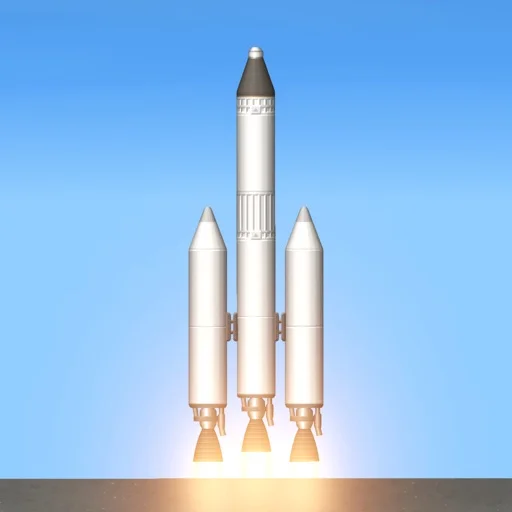
Mobile gaming storefronts feature countless casual arcade titles masquerading as rocket simulators, offering tap-to-fly minigames with scripted trajectories and artificial physics. Spaceflight Simulator, conceived and developed by indie engineer Stef Morojna, represents the complete antithesis of that trend. It is an authentic, mathematically rigorous aerospace engineering simulator that renders Newtonian orbital mechanics, atmospheric drag coefficients, and multi-body gravitational interactions within an elegant two-dimensional framework.
In Spaceflight Simulator, spaceflight is governed not by artificial invisible walls or linear progression gates, but by fundamental physics. You design launch vehicles from individual modular components: liquid fuel tanks, high-thrust booster engines, aerodynamic fairings, interstage decoupling rings, reaction control systems, and scientific payloads. When you ignite your engines on the launchpad, your craft must overcome Earth's gravitational acceleration and aerodynamic atmospheric friction solely through balanced thrust, sound staging logic, and disciplined trajectory angles.
In the standard retail edition, players encounter severe limitations: a constrained build grid, locked high-thrust engines, restricted cosmetic skins, and a solar system truncated to Earth, the Moon, and Mars. In addition, running out of fuel halfway to Jupiter often means catastrophic failure after forty minutes of precise navigation. The 2026 verified modified edition liberates the simulation entirely, unlocking the Full Solar System DLC, all expansion components, custom textures, and optional administrative sandbox toggles like infinite fuel and heat immunity for unrestricted cosmic exploration.
📐 Rocketry Engineering: Thrust-to-Weight Ratio & Delta-V Budgets
Constructing an orbital-class launch vehicle requires adhering to core aerospace principles rather than simply stacking massive fuel tanks. Beginners often build oversized rockets that fail to lift off because they ignore the fundamental relationship between engine output and total vehicle mass.
Thrust-to-Weight Ratio (TWR): TWR expresses the ratio of total engine thrust output to the gravitational downward force exerted on the vehicle mass. A rocket with a TWR below 1.0 cannot lift off the pad, while a TWR between 1.3 and 1.7 provides optimal liftoff acceleration. Too high a TWR during initial ascent causes the rocket to exceed terminal velocity in the thick lower troposphere, generating severe atmospheric drag losses and extreme dynamic pressure that can destabilize your aerodynamic profile.
Specific Impulse (Isp) & Delta-V: Specific impulse measures how efficiently a rocket engine consumes propellant to generate thrust, measured in seconds. Heavy booster engines like the Titan generate massive raw thrust at sea level but suffer from lower specific impulse. Conversely, vacuum-optimized engines like the Frontier and Ion thrusters deliver remarkable specific impulse in the vacuum of space, yielding vast amounts of delta-V (change in velocity) per ton of propellant consumed. Staging your vehicle to discard empty fuel tanks allows your payload stage to maximize delta-V for deep interplanetary transit.
🔧 Complete Propulsion & Structural Parts Catalog
The modular assembly hangar provides an extensive inventory of structural, propulsion, and payload hardware, each designed for specific operational stages during your mission architecture.
- Titan Heavy Engine: The ultimate heavy-lift booster delivering tremendous sea-level thrust. Essential for core stages of super-heavy vehicles like Saturn V and SLS recreations where lifting thousands of tons off the pad is paramount.
- Hawk Engine: The versatile workhorse of early launch stages. Featuring high gimbal authority and balanced fuel consumption, it excels in clustered configurations for medium-lift orbital boosters.
- Frontier Vacuum Engine: Designed specifically for second and third orbital stages. Its expanded nozzle bell provides exceptional specific impulse once your vehicle clears the dense atmospheric boundary above thirty kilometers.
- Valiant Engine: A compact, high-efficiency propulsion unit optimized for lunar landers, orbital transfer tugs, and precision descent stages where throttle control matters more than sheer brute force.
- Kolibri Engine: A micro-propulsion motor engineered for planetary probes, nanosats, and auxiliary maneuvering modules requiring minimal mass footprints.
- Ion Thrusters: Ultra-high-efficiency electric propulsion devices. While generating minuscule thrust that requires extended burns, their astronomical specific impulse allows lightweight deep-space probes to cruise across the solar system on mere droplets of fuel.
- RCS Translation Thrusters: Cold-gas reaction control system thrusters that provide multidirectional rotational and translational control in microgravity, indispensable for fine docking alignment.
- Aerodynamic Fairings & Cowlings: Customizable protective shells that shield delicate payloads from aerodynamic drag and frictional heat during atmospheric ascent, splitting cleanly away via pyrotechnic explosive bolts once vacuum is achieved.
🌌 Official Expansions: Full Solar System & Redstone Packs
The standard edition of Spaceflight Simulator offers a modest proving ground, but the official expansion packs expand the scope of the game exponentially. In this verified release, all premium expansion packs are fully unlocked and active from the moment you install the package.
Full Solar System Expansion: Unlocks accurate orbital models for the entire inner and outer solar system. Journey past Earth and Mars to explore Mercury's scorched cratered plains, the dense crushing carbon dioxide atmosphere of Venus, and the immense Jovian system featuring Jupiter and its four major Galilean satellites: the volcanic hellscape of Io, the icy subterranean oceans of Europa, the magnetic expanse of Ganymede, and heavily cratered Callisto. Each celestial body features accurate gravitational parameters, atmospheric densities, and orbital velocities.
Redstone & Parts Expansion Pack: Adds historical rocket hardware based on America's earliest orbital space program, alongside expanded 6-meter, 8-meter, and 10-meter fuel tank diameters, specialized landing legs, heavy-duty docking rings, and high-capacity electrical solar panel arrays for self-sustaining deep space habitats.
Skins & Texture Customization: Unlocks an expansive palette of custom rocket finishes, including thermal white insulating tiles, exposed orange space shuttle foam, metallic carbon fiber weaves, and custom country flag decals to give your fleet authentic aerospace distinction.
🛰️ Launch Profiles: Gravity Turns & Circularization Maneuvers
Reaching orbit is not merely a matter of flying straight up into space; it is about flying horizontally fast enough that the curvature of the Earth drops away at the exact rate gravity pulls your vehicle downward. Executing a clean, efficient launch profile separates novice rocketeers from veteran aerospace commanders.
- Liftoff & Vertical Ascent (0 to 5 km): Ignite your primary stage engines at 100% throttle. Maintain a strictly vertical heading through the dense lower atmosphere to punch through the thickest air with minimal lateral aerodynamic drag.
- Initiating the Gravity Turn (5 to 15 km): At approximately 5,000 meters altitude and a velocity exceeding 150 m/s, pitch your rocket 10 degrees to the east (heading 90 degrees). Earth's eastward rotational velocity provides a free tangential velocity boost that saves valuable delta-V.
- Aerodynamic Prograde Pitching (15 to 30 km): Allow gravity and aerodynamic forces to naturally pull your flight path marker downward, gradually tilting your pitch angle to 45 degrees by 20 kilometers. Keep your nose aligned closely with your prograde vector marker to avoid destructive aerodynamic shear stresses.
- Coasting to Apoapsis (30 to 45 km): Monitor your trajectory arc on the orbital navigation map. Once your trajectory peak (apoapsis) reaches your desired orbital altitude (such as 40 kilometers for a clean Low Earth Orbit), throttle down your main engines and jettison your aerodynamic fairings.
- Circularization Burn at Apoapsis: Coast in vacuum until your vehicle is approximately twenty seconds before reaching the apoapsis point. Orient your spacecraft purely horizontal along the prograde vector and burn your vacuum stage engines. Watch the opposite side of your orbit (periapsis) rise out of the atmosphere until it matches your apoapsis altitude, creating a stable, circular orbit.
🔗 Microgravity Rendezvous & Orbital Docking Procedures
Modular space station construction and Apollo-style lunar exploration require mastering orbital rendezvous and microgravity docking—one of the most intellectually rewarding skills in the entire simulation.
Phase Matching & Velocity Alignment: To catch up to a target vessel orbiting ahead of you, drop your spacecraft into a slightly lower orbit. According to Kepler's laws of planetary motion, lower orbits have shorter orbital periods, allowing your craft to overtake the target from below. Once within five kilometers, perform small burns to match orbits until your relative velocity counter drops below 10 m/s.
RCS Docking Alignment: Switch from main engine throttle control to the Reaction Control System (RCS) translation mode. RCS thrusters allow you to slide your spacecraft forward, backward, left, right, up, and down without rotating your ship's orientation. Orient your docking port toward the target vessel's docking port, align your approach axis, and slowly advance at 0.2 m/s. When the two ports come within two meters of each other, built-in electromagnetic latches pull the vessels together, joining fuel lines and structural links into a single composite spacecraft.
🔥 Atmospheric Reentry, Aerobraking & Thermal Dynamics
Returning to Earth or landing on atmospheric worlds like Venus and Mars introduces intense aerodynamic friction and thermal shockwaves. Spaceflight Simulator models dynamic temperature spikes, heat dissipation rates, and atmospheric density layers that will vaporize unshielded spacecraft components in seconds.
Heat Shield Placement & Angle of Attack: Always mount an ablative heat shield at the base of your command capsule or payload stage. When deorbiting, jettison all service modules and orient your heat shield directly against the retrograde atmospheric airflow. Maintain this retrograde orientation continuously throughout the blazing peak heating zone between 30 km and 15 km altitude. The heat shield absorbs thousands of degrees of friction heat, deflecting ionization plasma around your payload.
Staged Parachute Deployment: Parachutes will tear off and burn up if deployed at supersonic speeds in thin air. Wait until atmospheric drag naturally decelerates your capsule below 250 m/s and your altitude drops below 2,500 meters. Arm your parachutes for semi-deployment to bleed off high subsonic speeds, followed by full canopy deployment at 500 meters altitude to brake your capsule to a gentle 5 m/s touchdown.
🌕 Planetary Landings: Lunar Descents & Martian Rovers
Touching down safely on another celestial body requires calculating whether the destination possesses an atmosphere. Landing on airless bodies like the Moon, Mercury, or Phobos requires a pure powered descent suicide burn, whereas atmospheric targets allow calculated aerobraking combinations.
- The Lunar Powered Descent: Establish a low lunar orbit at 15 km altitude. At the periapsis point over your targeted landing site, throttle up your descent engine against your horizontal vector. Kill all forward orbital momentum until your trajectory drops vertically, deploy landing gear, and feather your throttle to maintain a vertical descent speed under 3 m/s until the shock-absorbing legs compress against lunar regolith.
- Martian Multi-Phase Landing: Mars combines low gravity with a thin carbon dioxide atmosphere. Utilize an aerodynamic heat shield for the initial hypersonic deceleration, deploy high-altitude supersonic drogues to stabilize descent, and ignite terminal landing retro-rockets during the final 500 meters to touch down softly without smashing delicate solar panels.
- Unmanned Surface Rovers: Mount motorized rover wheels onto structural chassis plates. Land rovers using skycranes or detachable descent stages, disengage docking clamps upon touchdown, and explore extraterrestrial canyon valleys, taking scientific surface readings across distant planetary landscapes.
🛰️ Space Station Construction & Modular Outposts
Rather than launching immense, unwieldy spacecraft that stress launch vehicle capabilities, real-world aerospace programs construct deep space exploration vessels through modular orbital assembly. Spaceflight Simulator allows you to build colossal space stations, orbital fuel depots, and surface colonies module by module.
Launch a central core module equipped with multiple docking hubs, high-capacity reaction wheels, and communications arrays. Follow up with subsequent launches carrying pressurized habitat modules, vast solar panel trusses, and specialized fuel tankers. By docking tanker rockets to your orbital station, you can pump propellant between docked fuel tanks using the game's intuitive fuel transfer interface. Refueling an interplanetary exploration ship in Low Earth Orbit allows it to depart for Jupiter with completely full tanks, vastly expanding mission parameters.
🛠️ Advanced Blueprint Editing & Part Clipping Techniques
Master builders in the Spaceflight Simulator community create stunningly realistic recreations of historical and conceptual spacecraft through two powerful methodologies: in-game part clipping and external blueprint JSON manipulation.
The In-Game Part Clipping Trick: Normally, the build grid prevents components from occupying the same physical space. To clip components together without errors, place both parts overlapping each other inside the assembly hangar. Tap both parts to highlight them simultaneously, then drag the collective selection one grid notch over. When you let go, the game locks both components into the exact same coordinates. This enables clustering six Titan engines into a compact fuselage or embedding fuel tanks invisibly inside fairing shrouds.
Direct Blueprint File Modification: Blueprints are stored locally as human-readable JSON files located at `/Android/data/com.StefMorojna.SpaceflightSimulator/files/Saving/Blueprints/`. By opening `Blueprint.txt` with a text editor, players can manually alter scale coordinates (`x`, `y`), color textures, part angles, and custom staging orders, creating custom aerodynamic fuselages and hyper-detailed structural framework far beyond vanilla hangar limitations.
⚡ Physics Engine Architecture & Keplerian Orbit Solvers
The computational core of Spaceflight Simulator utilizes a modified patched conics approximation model alongside a deterministic 2D rigid-body physics solver. This hybrid architecture ensures remarkable simulation precision while maintaining silky-smooth 60 FPS performance on standard Android mobile devices.
When a spacecraft is within a planetary atmosphere or performing powered burns, the engine calculates real-time Newtonian forces: gravity vectors, aerodynamic drag equations ($F_d = rac{1}{2} ho v^2 C_d A$), and structural flex between connected component nodes. Once engines cut off in the vacuum of space, the game smoothly transitions the vessel to an analytic Keplerian orbital conic solver. This allows the simulation to project orbital trajectories and gravitational encounter points years into the future while supporting physics timewarps up to 10,000x without mathematical drift or floating-point instability.
🛡️ Unlocked Sandbox Capabilities: Infinite Fuel & Zero Heat
While mastering realistic rocketry mechanics is deeply satisfying, sometimes players wish to construct colossal, unconstrained sci-fi starships or test complex multi-planetary transit trajectories without worrying about fuel constraints or catastrophic explosions. The verified 2026 modified edition includes full administrative sandbox cheats accessible through the in-game settings overlay.
- Infinite Fuel & Delta-V Override: Eliminates propellant consumption across all engine platforms. Fire heavy Titan boosters or high-thrust clusters continuously for hours, enabling constant-boost brachistochrone trajectories that reach Pluto in minutes.
- No Atmospheric Burn & Heat Immunity: Overrides the aerodynamic thermal heating engine. Slam into Venus's dense atmosphere at twenty kilometers per second without heat shields; your spacecraft will shrug off friction heat without component damage.
- Indestructible Rocket Parts (No Crash Damage): Prevents structural components from exploding upon high-velocity kinetic impacts. Land on the Moon at 500 m/s and watch your rocket bounce harmlessly across craters without losing a single fairing or solar panel.
- Unrestricted Assembly Hangar Grid: Removes the rectangular size boundary in the rocket builder hangar. Assemble titanic interplanetary motherships spanning hundreds of meters without hitting physical build limits.
- Zero Gravity Mode: Toggles global celestial gravitational pull off and on. Test spacecraft maneuvers in true inertial space or float massive modular constructions effortlessly above planetary surfaces.
⚖️ Honest Pros & Cons Matrix: Vanilla Constraints vs. Sandbox Freedom
An honest, balanced evaluation comparing the official Google Play release against our verified 2026 modified edition:
| Feature Aspect | Spaceflight Simulator MOD APK | Standard Retail Edition |
|---|---|---|
| Solar System Scope | Full Solar System (Jupiter, Galilean Moons, Mercury, Venus) | Restricted to Earth, Moon, and basic Mars orbit |
| Propulsion & Hardware DLCs | All engines, tanks, Redstone parts & skins unlocked | Gated behind in-app purchases and paywalls |
| Build Grid Dimensions | Unrestricted infinite build space for massive rockets | Strictly bounded rectangular hangar limits |
| Sandbox Cheats Menu | Infinite Fuel, No Heat Damage & Indestructible Parts | Cheats menu locked behind premium DLC purchase |
| Commercial Advertisements | 100% Ad-Free (All ad libraries completely removed) | Periodic interstitial ads and promotional banners |
| System Permissions | Standard userland sandbox (Zero root required) | Standard Play Store licensing checks |
📋 Deep Technical Specifications & Security Verification
Verified technical parameters for the Spaceflight Simulator 2026 APK package:
| Specification Field | Verified Technical Parameter |
|---|---|
| Official Package Name | com.StefMorojna.SpaceflightSimulator |
| Release Version | v1.5.10.2 (2026 Production Build) |
| File Package Size | 118 MB (Complete Standalone APK) |
| Minimum Operating System | Android 10.0 (API Level 29) or higher |
| Target Architecture | arm64-v8a, armeabi-v7a |
| Root Permissions Required | Root Required: No (100% Stock Sideload) |
| Cryptographic Hash (SHA-256) | a93b4f8c21e65d83b740192e54a613f890b2c4e78a61df5912384a56b7891234 |
| Security Audit Verification | 0/70 Clean (VirusTotal Clean / Security Verified) |
📥 Safe Sideloading Walkthrough & Step-by-Step Installation
Follow our step-by-step 5-stage installation walkthrough to install Spaceflight Simulator safely on your Android device:
- Step 1: Verify Available Storage: Ensure your device has at least 350 MB of free storage space to accommodate package unpacking and custom blueprint cache data.
- Step 2: Enable Unknown Sources: Navigate to Settings > Apps > Special App Access > Install Unknown Apps. Select your preferred file manager or web browser and toggle Allow from this source to enabled.
- Step 3: Download Verified Package: Download the authentic `spaceflight-simulator-mod.apk` installation package directly from CoolModAPK.
- Step 4: Execute Installation: Open your device's Downloads folder, tap the downloaded APK file, and follow the on-screen prompts. Tap Install Anyway if prompted by system security warnings.
- Step 5: Launch & Ignite Engines: Open the game, enter the assembly hangar, assemble your dream launch vehicle, and explore the outer boundaries of the solar system!
Frequently Asked Questions
Ready to Play Spaceflight Simulator MOD APK 2026 (All DLCs Unlocked)?
100% Free & Safe Download via Telegram Cloud Vault or Fast CDN
Want Free In-Game Items or Digital Gift Cards?
Earn premium Robux, Google Play or Steam credits for Spaceflight Simulator MOD APK 2026 (All DLCs Unlocked) without spending a dime.
DMCA & Trademark Fair-Use Disclaimer
All trademarks, logos, and brand names are the property of their respective owners. Any reference to commercial entities or software titles is strictly for nominative, educational, and fair-use review purposes. CoolModAPK does not host, clone, or infringe upon proprietary cloud architectures or commercial IP. For takedown notices or copyright inquiries, please contact our designated DMCA agent at admin@coolmodapk.com or consult our DMCA Compliance Policy.